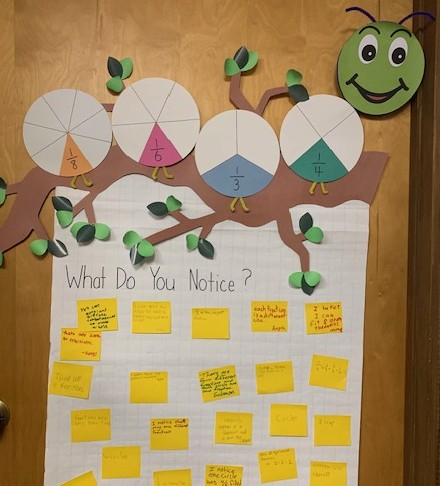
What Do You Notice? Caterpillar Sign-In
Back in January, I sent out a newsletter with a new activity I had created for my Math Medley Family Math Night: Caterpillar Sign-In. Along with the sign-in I had also created a What Do You Notice? “poster”. A What Do You Notice? poster gives students (and their families) an opportunity to think about and share their thoughts about the math they see reflected in the poster.
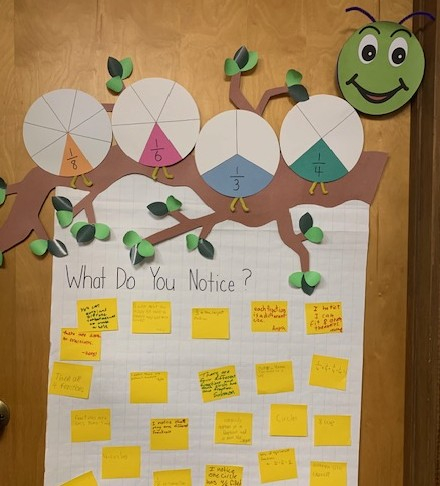
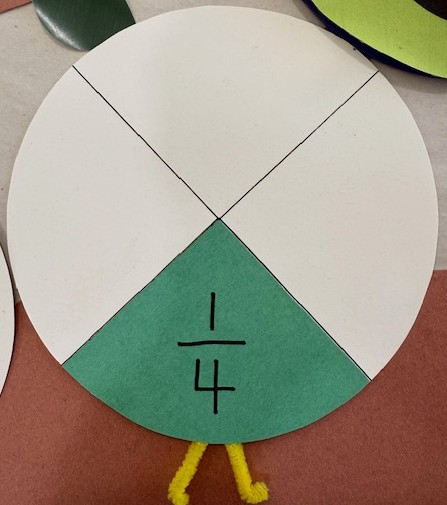
For this activity, I wanted students to visually see that one whole can be made up of equal parts that we call fractions. Fractions are the little bits in between whole numbers but they work just like “regular” numbers, all the same. A whole divided into 4 equal parts, or fourths, can be represented by the addition of those parts: 1/4 + 1/4 + 1/4 + 1/4 = 1 whole. That said, denominators can confuse students. So having a variety of hands-on experiences seeing and working with fractions is important.
Although this activity focused mostly on upper elementary work with fractions, there was still plenty for the young ones to notice.
Note: I created each of the fraction circles using a protractor. See my blog post for details.
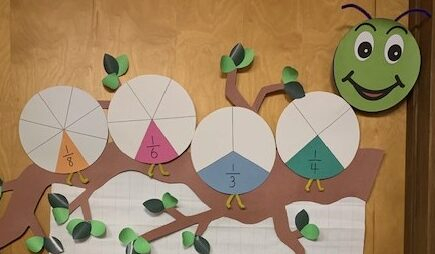
For example, younger students could notice circles. They could also count how many circles they see. Did they notice the head was also a circle? On a little deeper level, they could count the individual sections of each circle and notice that one of the sections was colored in.
They might notice that those sections look like triangles. This is a good opportunity to mention that a triangle is made up of three straight lines…but, yes, those sections are definitely similar to triangles.
Although students at this age do not understand fractional notation, they could notice and identify some of the written numbers. In other words, for the written fraction 1/4, they could identify the ‘1’ and the ‘4’.
Maybe they notice that the caterpillar has two eyes and two eyebrows and two antennae. Then there are the cute little legs in multiples of 2: 2, 4, 6, 8…what comes next?
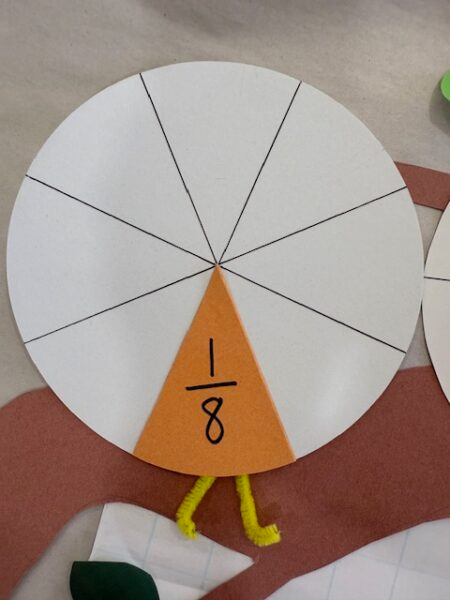
My goal for the older students was to get them to notice how each of the circles was divided into equal parts and collectively those parts equaled one whole. I deliberately just highlighted one of the fractional parts to encourage students to count and see that the denominator represented how many total parts needed to make the whole.
I was also hoping that this would lead them to notice that the fraction 1/8 was the smallest fraction represented even though the denominator, 8, was greater than the denominator 4 in the fraction 1/4.
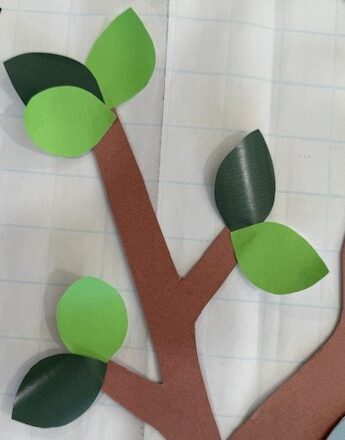
Very observant students would notice that the leaves on the branches had a pattern – they came in bunches of two or three. And those bunches had a color pattern. All of the two-leaf bunches had one light and one dark green leaf. All of the three-leaf bunches had two light green and one dark green leaf. And those three leaves followed the pattern: light green, dark green, light green. These students could determine how many leaves there were altogether by noticing that there were five three-leaf bunches and seven two-leaf bunches:(5 x 3) + (7 x 2)
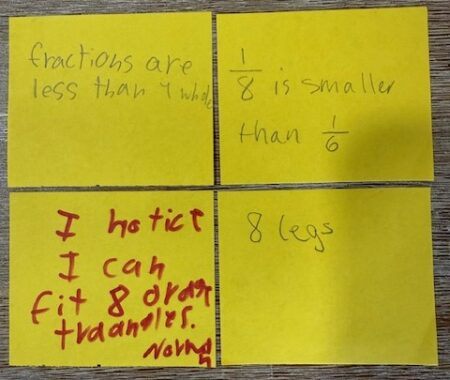
Here are some of the things students noticed:
“Fractions are less than 1 whole.”
“I notice I can fit 8 orange triangles.” (Referring to eighths.)
“8 legs.”
“1/8 is smaller than 1/6.”
Not only is this a fun activity to do at a Family Math Night event, it would be a fabulous activity in the classroom!
If you like this What Do You Notice? poster, we have a lot more! Click the here to check them out.