Browsed by
Tag: elementary math

Family Math Night and ESEA – What the Research Says

Family Math Night and ESEA – What the Research Says


Decades of research has clearly indicated that there is a strong relationship between family engagement and student academic success. According to Henderson and Mapp1, students whose parents are involved in their schooling, regardless of family income or background, are more likely to:

  • have higher grades and test scores
  • attend school regularly
  • have better social skills
  • show improved behavior
  • adapt well to school

Today’s schools know that educating our children requires a team effort and that building connections between families and schools is key to developing academic achievement for all children. One way to build these connections is through Family Math Night events. Hosting a Family Math Night can help build strong family-school partnerships, engage parents meaningfully, and contribute to achieving high standards.

Read More Read More

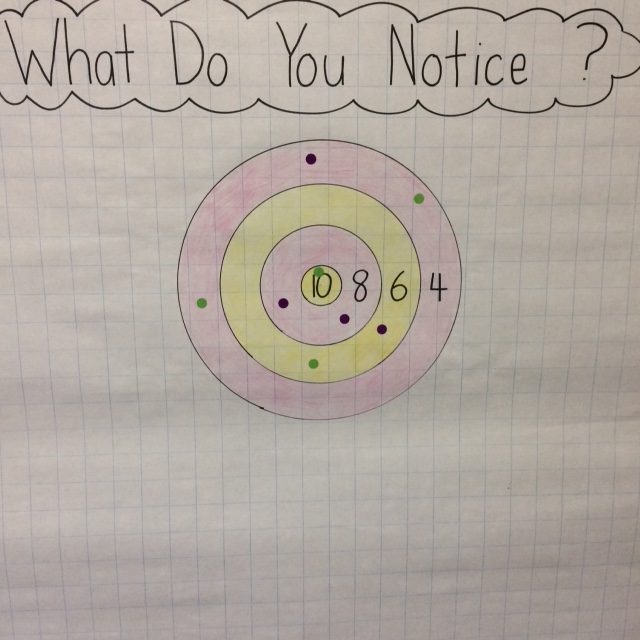
What Do You Notice? Target Practice

What Do You Notice? Target Practice


Skills:
K-2: number recognition, counting, pattern, addition, geometry
3-5: addition, even numbers, geometry


The idea to do something with a target came to me when I was watching the World Curling Championships. Although the sport of curling doesn’t use number values for each of the rings, it reminded me of archery targets which do have number values, although not necessarily indicated on the target itself.

Read More Read More

What Do You Notice? Scales

What Do You Notice? Scales


Skills:
K-2: counting, number recognition, comparing, addition/subtraction, logic/reasoning skills, geometric shapes
3-5: logic/reasoning skills, addition/subtraction, beginning algebra


This scale weight problem is a fun way to introduce algebraic thinking. Although for the young students, simply recognizing numbers and counting the animals is good enough. They can even describe the geometric shapes used to make the scales.

Read More Read More

What Do You Notice? Number Theory

What Do You Notice? Number Theory


Skills:
K-2: counting, skip counting, patterns, even/odd numbers
3-5: even/odd numbers, patterns, multiples, factors, multiplication, common multiples, prime/composite numbers


When students learn to skip count* they are reciting the multiples of the number they started with. It’s a great early introduction to multiplication. This poster is a horizontal representation of some of the multiples for numbers 1 – 23 which are represented by different colors. For example, multiples of 1 are magenta; multiples of 2 are yellow; 3 are green, etc.

Factors are the numbers multiplied together to arrive at another number. For example, 2 and 3 are the factors that, when multiplied, result in the product 6. This poster shows the factors of each number vertically. The factors of 6 are: 1 (magenta), 2 (yellow), 3, (green), and 6 (blue).

1 x 6 = 6 and 2 x 3 = 6

Read More Read More

Power Packs and Math Homework

Power Packs and Math Homework


Everyone loves to play games. They’re engaging, motivating, and fun. And from an educational perspective, they can be a powerful learning tool. Here’s what games can do:

  • reinforce skills learned in the classroom
  • develop mental math skills
  • encourage strategic thinking
  • foster mathematical communication
  • build confidence
  • engage parents

But one of the best things about games is that they offer meaningful practice in a way where kids actually want to do math. That’s because games, by their very nature, are fun. It’s not too hard to entice a child to play a game. And because of that, games offer important practice in a way that worksheets can’t.

Read More Read More