Browsed by
Tag: math night

What Do You Notice? Number Theory

What Do You Notice? Number Theory


Skills:
K-2: counting, skip counting, patterns, even/odd numbers
3-5: even/odd numbers, patterns, multiples, factors, multiplication, common multiples, prime/composite numbers


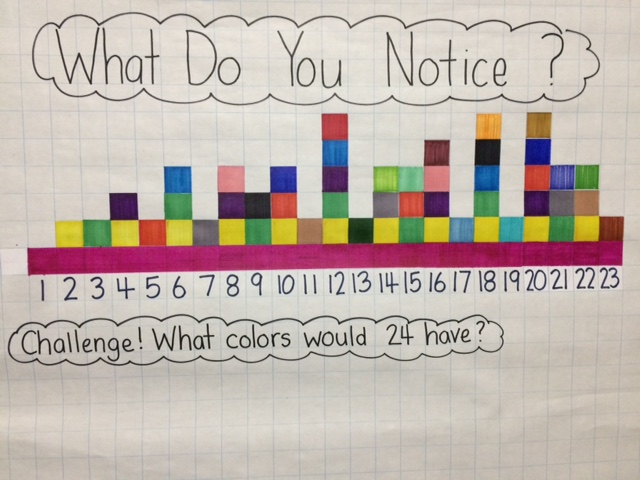
When students learn to skip count* they are reciting the multiples of the number they started with. It’s a great early introduction to multiplication. This poster is a horizontal representation of some of the multiples for numbers 1 – 23 which are represented by different colors. For example, multiples of 1 are magenta; multiples of 2 are yellow; 3 are green, etc.

Factors are the numbers multiplied together to arrive at another number. For example, 2 and 3 are the factors that, when multiplied, result in the product 6. This poster shows the factors of each number vertically. The factors of 6 are: 1 (magenta), 2 (yellow), 3, (green), and 6 (blue).

1 x 6 = 6 and 2 x 3 = 6

Read More Read More

What Do You Notice? Gumballs

What Do You Notice? Gumballs

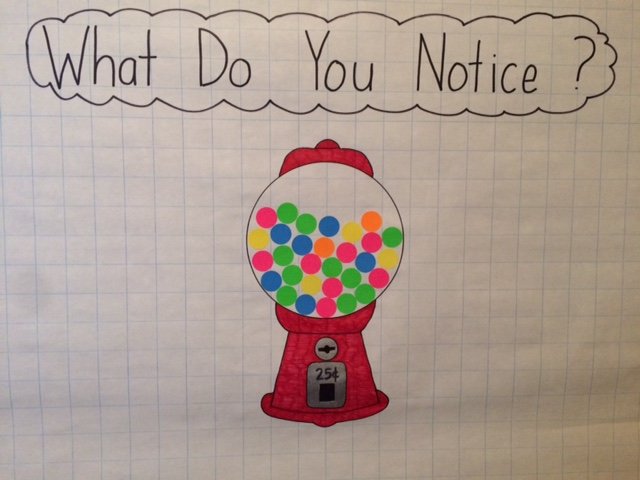
So this was a super fun What Do You Notice? poster I created for my last Family Math Night event. Not only is it colorful, but who doesn’t like gumball machines?!


Skills:
K-2: counting, even numbers, skip counting by twos, comparison
3-5: probability, fractions, money


This is a fun one simply because of the fun gumballs and gumball machine. That said, there is still a lot of math going on. Young students can count the number of different colored gumballs. They can compare colored gumballs to see which color has the least and which color has the most. They can even count all the gumballs to arrive at a total.

Read More Read More

Homework the FUN Way

Homework the FUN Way

Everyone loves to play games. They’re engaging, motivating, and fun. And from an educational perspective, they can be a powerful learning tool. Here’s what games can do:

  • reinforce skills learned in the classroom
  • develop mental math skills
  • encourage strategic thinking
  • foster mathematical communication
  • build confidence
  • engage parents

But one of the best things about games is that they offer meaningful practice in a way where kids actually want to do math. That’s because games, by their very nature, are fun. It’s not too hard to entice a child to play a game. And because of that, games offer important practice in a way that worksheets can’t.

Read More Read More

The Power of the Estimation Jar

The Power of the Estimation Jar


We often think of math as the exact-answer subject. But the kind of math that we do most often during the day doesn’t require an exact answer. We use this particular math skill when we need to figure out how much time we need to get ready in the morning. Or whether we have enough gas in the car to get to work. Or whether $50 is enough to cover the items in our shopping cart.

The math skill we use the most is, of course, estimation. And estimating accurately requires a high level of math. That’s because it’s abstract which means we need to tap into our number sense and reasoning skills.

One way to provide our students with opportunities to work on their estimation skills is during computation practice. Instead of diving right in to figure out 15 x 12, have students come up with an estimate…about what the answer will be. In fact, periodically I ask students NOT to determine the exact answer and, instead, have them turn in their work with only their estimates recorded. This is hard for them to do in the beginning because they are so used to working out arithmetic problems, but they soon learn the value in thinking about the problem first.

A fun way to get students to work on their estimating skills is through the estimation jar. I’ve included two of my estimation videos below. The first video describes using the estimation jar in the classroom as a way to develop, not only estimation skills, but place value and number sense, as well.

Read More Read More

New Family Math Night Collaborative Projects: Fish Bowl and Fraction Quilt

New Family Math Night Collaborative Projects: Fish Bowl and Fraction Quilt

In addition to using the 8 stations in our Family Math Night kits, I usually include a ninth station where I set up a Collaborative Project.  I did the soccer ball project at my first event this year but then created two brand new ones that I’m excited to share with you:  Fraction Quilt and Fish Bowl. In Fraction Quilt, participants cut different colored squares into triangles and use those triangles to design their quilt square. Some of the math they’ll discover along the…

Read More Read More