Family Math Night Website Update
We just updated our website to make it a little easier to navigate. Check it out here (or click the logo above).
We just updated our website to make it a little easier to navigate. Check it out here (or click the logo above).

Skills:
K-2: number recognition, counting, geometry
3-5: addition/subtraction, patterns, odd numbers
This is a fun puzzle where the main objective is to figure out where the three missing numbers of the “spokes” are placed. Since the numbers 1, 2, 5, 6, 7, 8, and 9 are visible, the missing numbers would be 3, 4, and 10 (assuming we are using the consecutive numbers 1 – 10. There is an alternate solution for the missing numbers 0, 3, and 4 which is described below).
Younger students may notice a circle, a square, and (10) “triangular” pie pieces. They will probably notice that some of the spokes are missing numbers. Starting at 1 and counting on, they may discover the three missing numbers: 3, 4, and 10. It would be interesting to ask them where they think the numbers go on the wheel and why they chose those specific spokes.
Older students will quickly notice three missing numbers. With a little bit of guidance, they should be able to notice some patterns that can help them determine where the missing numbers should be placed.
We are living through a historic moment in history that has brought about some major changes to our lives. As an elementary math educator, I wanted to figure out a way for students to capture this moment through a math activity. That’s when I came up with the idea of creating a time capsule.
I presented the activity a few weeks ago as a webinar for a homeschooling consortium but when we lost the video of the presentation, I decided to film it again and am including it for you below.
It’s a simple but fun project that the whole family can do. With a little adaptation, it would work in the virtual classroom, as well.
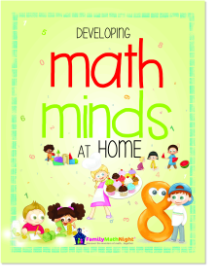

I’m happy to announce that our parent guide Developing Math Minds at Home is now complete.
The guide was designed to help families support math learning at home. As parents work on reinforcing math skills, it’s also important that we show them how to help their children develop a strong math mind. As we describe in the guide, “Children with a strong math mind are comfortable using math. They understand that math is a useful part of our everyday lives and are confident using it to solve problems.”
The guide underscores what the current research says about how children learn math and includes topics such as:
We also have a Spanish version of the booklet. For a sample page, check out our website.

Family Math Nights are usually done at school but I created one that families can do at home. This comprehensive resource includes video tutorials, check lists, materials lists, and activity sheets for four home-friendly activities for grades K-5. I’m including the video below.
My goal was to design the Family Math Night/Day to be different than simply doing a math activity at the kitchen table. It’s their own personal event and I walk them through how to do it step-by-step. Watch the video below for tips on making it a special event.
Here is the link so you can access all the activity PDFs:
https://familymathnight.com/resources/mathathome.php
Here is the link so you can access the video:
https://www.youtube.com/watch?v=GknJtgZ47KQ