Browsed by
Category: Problem-Solving

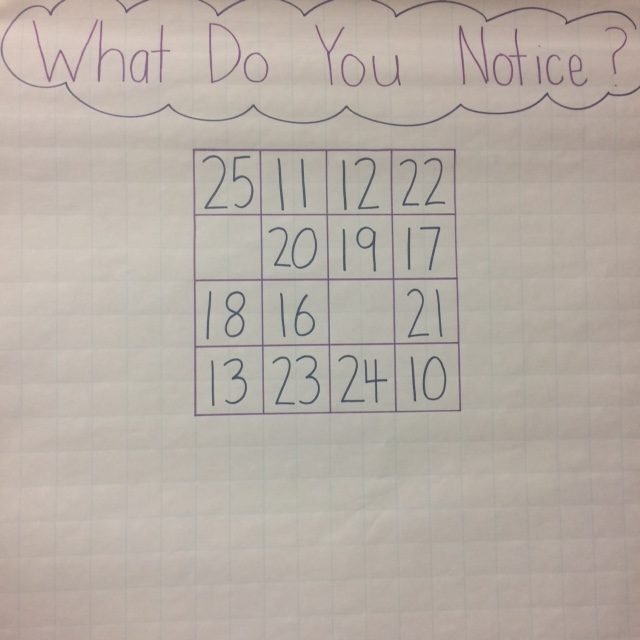
What Do You Notice? Magic Square

What Do You Notice? Magic Square


Skills:
K-2: counting, number recognition, comparing, geometric shapes
3-5: even/odd numbers, addition/subtraction


In a magic square, all the rows, columns, and diagonals add to the same number. In our case, the numbers all add to 70. Usually, a magic square starts off with a few numbers filled in and participants figure out all the missing numbers. For this activity, though, I wanted participants to focus on the numbers in the grid so I only left two small squares empty.

At a beginning level, students can simply notice that there are numbers and point to numbers they recognize. They can count how many of each digit they see. Some of these students may even be able to “read” some of the double-digit numbers.

Some participants will notice squares. The grid is a 4 by 4 so there are 16 squares for numbers. (There are technically a lot more than 16 total squares and this may be a challenge to put out to the older students.)

Read More Read More

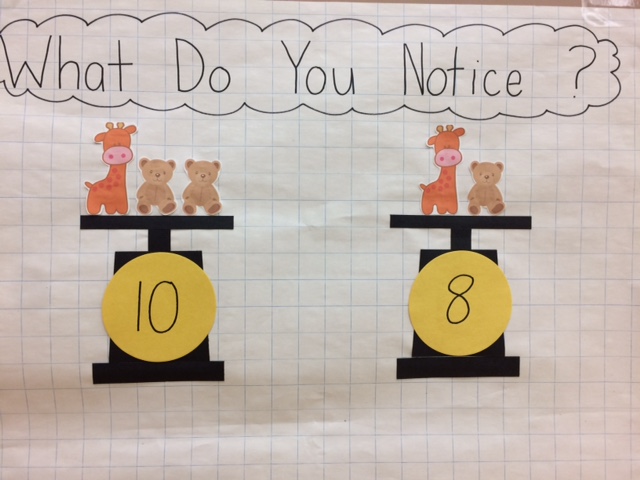
What Do You Notice? Scales

What Do You Notice? Scales


Skills:
K-2: counting, number recognition, comparing, addition/subtraction, logic/reasoning skills, geometric shapes
3-5: logic/reasoning skills, addition/subtraction, beginning algebra


This scale weight problem is a fun way to introduce algebraic thinking. Although for the young students, simply recognizing numbers and counting the animals is good enough. They can even describe the geometric shapes used to make the scales.

Read More Read More

What Do You Notice? Number Theory

What Do You Notice? Number Theory


Skills:
K-2: counting, skip counting, patterns, even/odd numbers
3-5: even/odd numbers, patterns, multiples, factors, multiplication, common multiples, prime/composite numbers


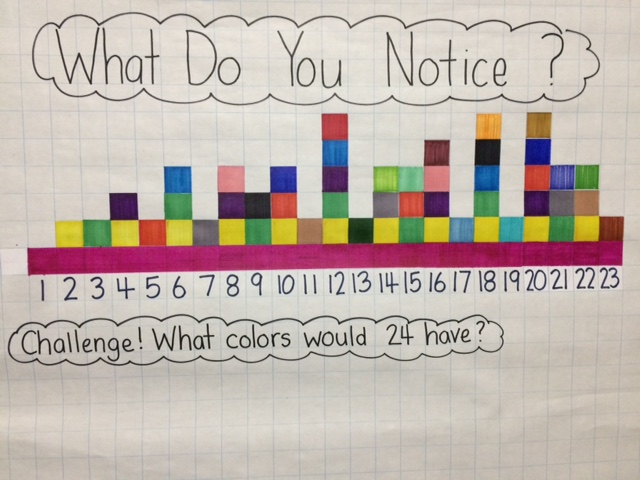
When students learn to skip count* they are reciting the multiples of the number they started with. It’s a great early introduction to multiplication. This poster is a horizontal representation of some of the multiples for numbers 1 – 23 which are represented by different colors. For example, multiples of 1 are magenta; multiples of 2 are yellow; 3 are green, etc.

Factors are the numbers multiplied together to arrive at another number. For example, 2 and 3 are the factors that, when multiplied, result in the product 6. This poster shows the factors of each number vertically. The factors of 6 are: 1 (magenta), 2 (yellow), 3, (green), and 6 (blue).

1 x 6 = 6 and 2 x 3 = 6

Read More Read More

Family Math Night Project Series: Bug Box

Family Math Night Project Series: Bug Box


I’m very excited to share with you our newest Family Math Night product line designed around hands-on projects in math. We’re calling it our Project Series and the first one, just released, is Project: Bug Box.


Hands-on and super fun, this Family Math Night Bug Box station will get the creative juices flowing! Participants choose one of their favorite (plastic!) bugs and use 2- and 3-dimensional geometry along with number skills to create a rectangular prism. Participants will walk away with a custom designed box for their bug which they get to bring home and share with others.

Read More Read More

What Do You Notice? poster – Number Grid Puzzle

What Do You Notice? poster – Number Grid Puzzle


Skills:
K-2: number recognition, pattern
3-5: pattern, addition


My youngest son visited the Basilica Sagrada Familia, a Roman Catholic Church in Barcelona, Spain and brought this pattern back for me as a gift. Here’s a photo of his gift: (And before you read the next paragraph where I describe the main pattern, you may want to discover your own patterns first.)

Read More Read More