Browsed by
Category: Problem-Solving

Play-N-Take 3 Math Games

Play-N-Take 3 Math Games

I’m very excited to share with you our latest Family Math Night and parent engagement product – Play-N-Take 3. In the video below I describe these super fun and engaging math games. But first, I want to share with you two recent reports that underscore in a very big way the importance of early math skills. The first is from the Thomas B. Fordham Institute and synthesizes recent research from the Urban Institute’s Income and Benefits Policy Center. This line from the article sums…

Read More Read More

Fibonacci Flower Garden Collaborative Project

Fibonacci Flower Garden Collaborative Project

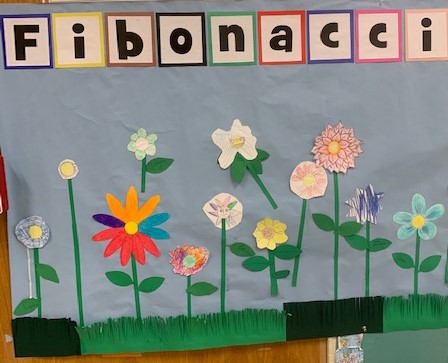
I’m always looking for ways to combine math and art into a fun activity. I’m also always looking for ways to show students that we’re surrounded by math in ways we aren’t necessarily aware of. That brings me to a recent Family Math Night Collaborative Project. In this project I used the Fibonacci numbers to have participants create a Fibonacci Flower Garden. Fibonacci numbers are a sequence of numbers that are generated by adding the previous two numbers starting with 0 and…

Read More Read More

What Do You Notice? Pie Graph

What Do You Notice? Pie Graph

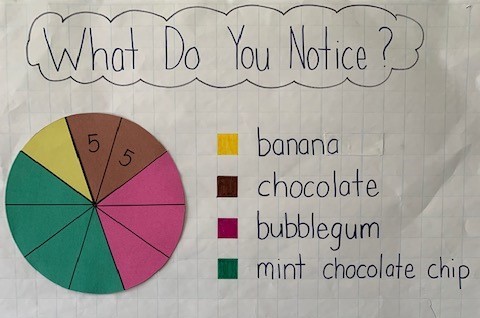
There’s been a big push to get students looking at and analyzing data. So I’m excited to share with you one of my latest What Do You Notice? posters…a poster that gives students (and their families) an opportunity to think about and share their thoughts about the math they see. For this poster, I created a simple pie graph as a fun way to show students how information can be visually organized. That said, as you’ll see in the description below, there’s a lot…

Read More Read More

What Do You Notice? Number Wheel

What Do You Notice? Number Wheel


Skills:
K-2: number recognition, counting, geometry
3-5: addition/subtraction, patterns, odd numbers


This is a fun puzzle where the main objective is to figure out where the three missing numbers of the “spokes” are placed. Since the numbers 1, 2, 5, 6, 7, 8, and 9 are visible, the missing numbers would be 3, 4, and 10 (assuming we are using the consecutive numbers 1 – 10. There is an alternate solution for the missing numbers 0, 3, and 4 which is described below).

Younger students may notice a circle, a square, and (10) “triangular” pie pieces. They will probably notice that some of the spokes are missing numbers. Starting at 1 and counting on, they may discover the three missing numbers: 3, 4, and 10. It would be interesting to ask them where they think the numbers go on the wheel and why they chose those specific spokes.

Older students will quickly notice three missing numbers. With a little bit of guidance, they should be able to notice some patterns that can help them determine where the missing numbers should be placed.

Read More Read More