Browsed by
Category: Fractions

What Do You Notice? Lego Blocks
What Do You Notice? Lego Blocks


Skills:
K-2: counting, subitizing, geometric shapes
3-5: skip counting, repeated addition, multiplication, beginning algebra


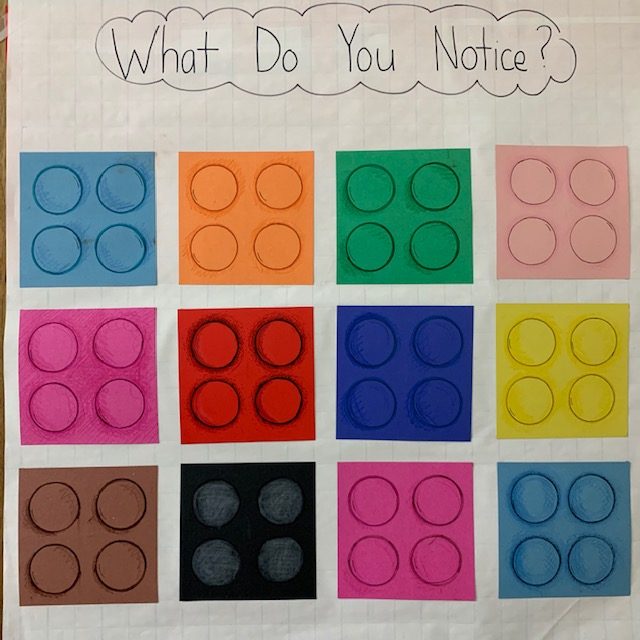
Although there are no numbers represented, this What Do You Notice? poster is filled with number concepts. Young students should be able to quickly recognize that there are 4 circles on each square (subitizing). From there, they can decide how they want to count circles. Maybe they want to count just the circles on the pink squares or blue squares. Or maybe they want to count all the circles to arrive at the total number. Others may notice the squares and decide to count how many squares there are all together.

Older students can use repeated addition to determine the total number of squares (4 + 4 + 4 or 3 + 3 + 3 + 3) or they can multiply 3 x 4 or 4 x 3.

There are a variety of ways these students can determine the total number of circles: skip counting by fours; determining the total number of circles in a row and multiplying that by 3; multiplying the total number of squares by 4, multiplying 6 circles x 8 circles, etc.

Read More Read More

Family Math Night Collaborative Project: Rose Window

Family Math Night Collaborative Project: Rose Window

I’m very excited to share with you my latest Family Math Night Collaborative Project: Rose Window. I was inspired to do this project after visiting the beautiful Chartres Cathedral in France.

Here is the final result:


The theme for this rose window is geometry and fractions. I can’t think of a more fun way to get in some important work in fractions! As with each of my Family Math Night Collaborative Projects, I put together a video where I walk you through each of the three activities and give tips on station set-up.

Read More Read More

What Do You Notice? Gumballs

What Do You Notice? Gumballs

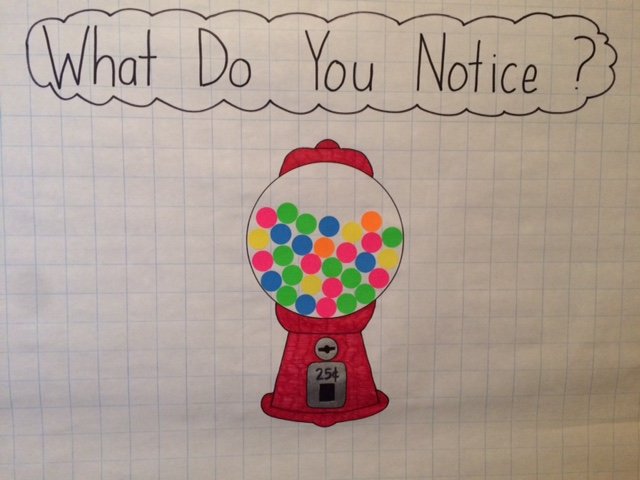
So this was a super fun What Do You Notice? poster I created for my last Family Math Night event. Not only is it colorful, but who doesn’t like gumball machines?!


Skills:
K-2: counting, even numbers, skip counting by twos, comparison
3-5: probability, fractions, money


This is a fun one simply because of the fun gumballs and gumball machine. That said, there is still a lot of math going on. Young students can count the number of different colored gumballs. They can compare colored gumballs to see which color has the least and which color has the most. They can even count all the gumballs to arrive at a total.

Read More Read More

What Do You Notice? poster – Fractions on the Geoboard

What Do You Notice? poster – Fractions on the Geoboard


Skills:
K-2: shapes, counting, area
3-5: congruency, area, fractions, equivalent fractions


This is similar to the Squares and More Squares poster. Like that one, this was designed around fractions but at a higher level. The dots for each square represent the dots on a regular geoboard. Each square is made up of 5 by 5 dots. If lines were drawn connecting each of the dots, the larger square would show 16 small squares (4 x 4 small squares). Each of these small squares represents one square unit.

Read More Read More

Homework the FUN Way

Homework the FUN Way

Everyone loves to play games. They’re engaging, motivating, and fun. And from an educational perspective, they can be a powerful learning tool. Here’s what games can do:

  • reinforce skills learned in the classroom
  • develop mental math skills
  • encourage strategic thinking
  • foster mathematical communication
  • build confidence
  • engage parents

But one of the best things about games is that they offer meaningful practice in a way where kids actually want to do math. That’s because games, by their very nature, are fun. It’s not too hard to entice a child to play a game. And because of that, games offer important practice in a way that worksheets can’t.

Read More Read More