Browsed by
Category: Math Phobia/Anxiety

How Our Take-Home Games Helped Reinforce Essential Math Skills and Support Parent/Teacher Communication – a Case Study

How Our Take-Home Games Helped Reinforce Essential Math Skills and Support Parent/Teacher Communication – a Case Study

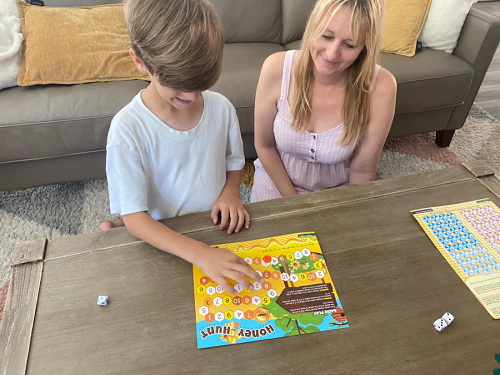
Objective One of our goals at Math Unity has always been to engage families in fun hands-on math activities that are linked to learning. We know that when schools and families partner together around the common goal of educating students, learning improves and students make greater academic gains. The objective for this study was two-fold. The first was to see if our games engaged families in hands-on math in a way that reinforced essential math skills. The second was to see…
Read More Read More

Developing Math Minds at Home Parent Guide

Developing Math Minds at Home Parent Guide


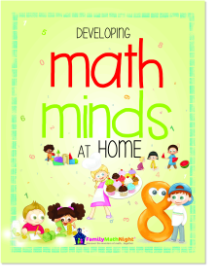
I’m happy to announce that our parent guide Developing Math Minds at Home is now complete.

The guide was designed to help families support math learning at home. As parents work on reinforcing math skills, it’s also important that we show them how to help their children develop a strong math mind. As we describe in the guide, “Children with a strong math mind are comfortable using math. They understand that math is a useful part of our everyday lives and are confident using it to solve problems.”

The guide underscores what the current research says about how children learn math and includes topics such as:

  • Fostering a Growth Mindset
  • Supporting a Positive Attitude Towards Mathematics
  • Promoting Critical Thinking and Problem-Solving Skills
  • Developing Number Sense
  • Solving Problems a Variety of Ways
  • Embracing Mistakes
  • Encouraging Positive Self-Talk

We also have a Spanish version of the booklet.  For a sample page, check out our website.

Read More Read More

Power Packs and Math Homework

Power Packs and Math Homework


Everyone loves to play games. They’re engaging, motivating, and fun. And from an educational perspective, they can be a powerful learning tool. Here’s what games can do:

  • reinforce skills learned in the classroom
  • develop mental math skills
  • encourage strategic thinking
  • foster mathematical communication
  • build confidence
  • engage parents

But one of the best things about games is that they offer meaningful practice in a way where kids actually want to do math. That’s because games, by their very nature, are fun. It’s not too hard to entice a child to play a game. And because of that, games offer important practice in a way that worksheets can’t.

Read More Read More

Math…it’s a Workout

Math…it’s a Workout

“Your workout has to be fun. You’re not going to stick with it if it isn’t fun.” I hear this every time I’m in the middle of a difficult workout. And every time I hear it I want to ‘bop’ the lady on the DVD who is guiding me through the “fun”.

It’s not always easy, but I try to get in a workout several times a week. Unlike the opinion of Ms. DVD, however, working out is not always a lot of fun. There’s usually some pain involved. Those lunges hurt.

So the other day when she repeated herself for the umpteenth time, I started to think about why I continue to pop in that DVD and torture myself for 40 minutes. After all, she said it was supposed to be fun and I wasn’t feeling the fun. I just wanted the workout to be over so I could get that sense of accomplishment that comes with knowing you’ve done something good for yourself.

And there it was. My motivator. That sense of accomplishment. And I was willing to endure some pretty tough exercises in order to get it.

But there was another motivator, too. Results. If I didn’t get any results from my pain, well then it wouldn’t be worth doing.

It’s the same in the math classroom. Some math problems are not fun. And some math problems are not easy. But that doesn’t mean that they’re not important to do. The key is to help students make connections between the problems they’re working on and the reasons for doing them. We need to show them the benefits.

Read More Read More

The Two Most Important Questions to Ask Your Kids

The Two Most Important Questions to Ask Your Kids

Okay, so I’m talking about the two most important questions you can ask your kids to help develop mathematical thinking. Wait! Don’t go. Math often receives short shrift. It’s unfortunate because math, taught correctly, teaches us how to effectively problem solve. It’s also the perfect subject to teach our kids persistence. Research has shown that kids who are persistent tend to do better academically. And doing well academically has great benefits in life. The two most important questions: #1: WHY?…

Read More Read More